


New Mandatory Primary School Timings
New Mandatory Primary School Timings government of Khyber Pakhtunkhwa has officially introduced a new timetable for public primary schools, which will be implemented from April 1 across the province. This decision has come at a time when there is increasing focus on improving the quality of education, discipline, and student engagement in government schools. The new schedule is not just about changing school hours; it is part of a broader plan to reshape how students learn and participate in school activities on a daily basis.
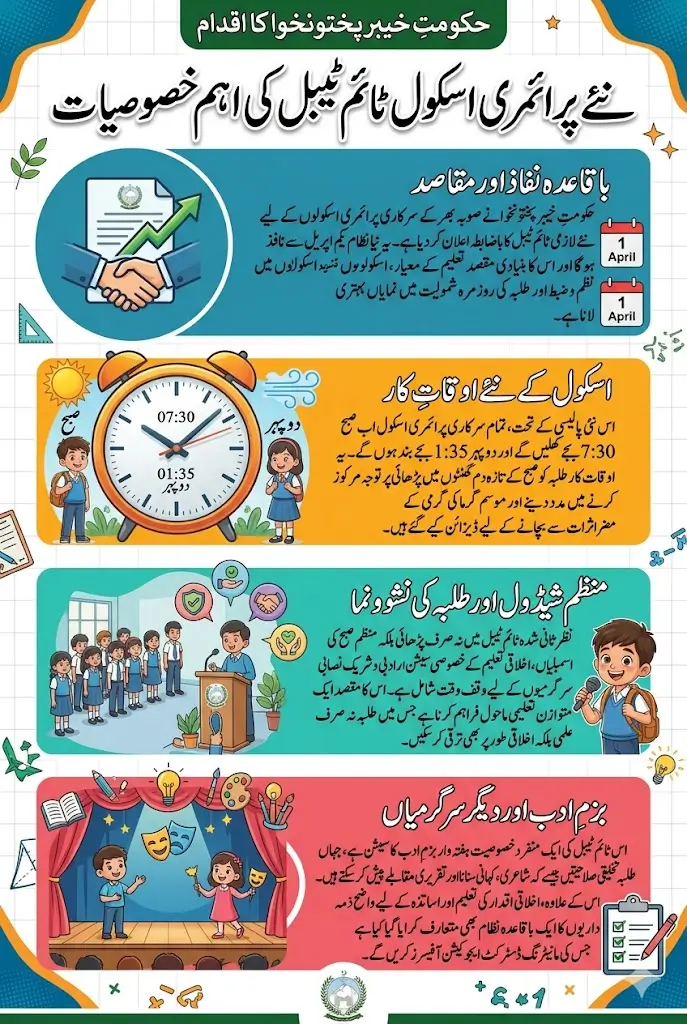
According to the statement issued by Arshad Ayub Khan, the revised timetable includes structured morning assemblies, moral education, and dedicated time for literary and co-curricular activities. These changes clearly show that the provincial government is aiming to create a balanced education system where students can grow academically as well as socially. In many areas of Pakistan, especially in public sector schools, such structured reforms are often needed to bring noticeable improvement in learning outcomes.
For parents and teachers, this announcement carries importance because it directly affects daily routines. Students will now have to adjust their waking hours, transportation timing, and study schedules accordingly. At the same time, teachers will also be required to follow a more organized system that includes both teaching and administrative responsibilities within school hours.
You Can Also Read: Solar Consumers New Electricity Charges In April 2026
Revised School Opening and Closing Hours
Under the new policy, all primary schools in Khyber Pakhtunkhwa will now open at 7:30 a.m. and close at 1:35 p.m. This timing has been designed to utilize the early hours of the day when students are usually more fresh and attentive. In many regions of KP, especially during the summer months, early school timings also help avoid extreme heat later in the day, which can affect student concentration and health.
This change may seem simple, but it can have a strong impact on the overall learning environment. Students who start their day early tend to develop better discipline and time management skills. Parents, however, may initially face some challenges in adjusting their morning routines, especially in rural areas where transportation facilities are limited. مدارس کے اوقات میں یہ تبدیلی طلبہ کو وقت کی پابندی اور نظم و ضبط سکھانے میں اہم کردار ادا کرے گی۔
You Can Also Read: Eid al-Adha 2026 Date Revealed in Pakistan
New School Timings at a Glance
| School Category | Opening Time | Closing Time |
|---|---|---|
| Primary Schools (KP) | 7:30 AM | 1:35 PM |
In addition to these fixed hours, schools are expected to strictly follow the timetable without unnecessary delays or early closures. This step is being taken to ensure uniformity across all districts and to avoid the common issue of inconsistent school timings.
Key highlights of the new timing policy include:
- Early start to improve student focus and productivity
- Fixed closing time to maintain consistency
- Better use of daylight hours for learning activities
- Alignment with seasonal conditions in KP
You Can Also Read: Oshan X7 Price Pakistan Reviews & Specs
New Assembly Guidelines for Students
The morning assembly in schools is now being given a completely new direction. Instead of being a routine activity limited to prayer and announcements, it will now serve as a platform for student development. The government has made it mandatory to include moral training, speeches, and practical activities during assembly time.
This step is particularly important because it encourages students to actively participate rather than just stand in lines. When students deliver speeches or take part in activities, they gain confidence and learn how to express their thoughts in front of others. Over time, this can help in improving communication skills, which are often weak among students in government schools.
The updated assembly structure will include:
- Short speeches on daily or weekly topics
- Moral lessons based on real-life situations
- Interactive activities to engage students
- Opportunities for students to lead segments of the assembly
Such changes are expected to make assemblies more meaningful and productive. Teachers will also play an important role in guiding students and ensuring that the activities are well-organized and beneficial.
Weekly Moral Education Plan Introduced
The new timetable places strong emphasis on moral education, which is often missing in traditional classroom teaching. The Education Minister has clearly instructed schools to follow a weekly plan where different methods of learning are used to teach values and ethics.
Under this plan, students will participate in structured activities throughout the week. Instead of relying only on textbooks, schools will use practical methods such as speeches and skits to explain moral concepts. This approach is more effective because students can relate these lessons to real-life situations.
The weekly structure will be as follows:
- Three days dedicated to student speeches on moral topics
- Three days focused on skits and role-playing activities
- Topics may include honesty, respect, responsibility, and teamwork
This balanced method ensures that students not only learn values but also understand how to apply them in their daily lives. In Pakistani society, where character building is considered very important, such initiatives can play a key role in shaping the future generation.
You Can Also Read: 8th Class Result 2026 Check Result By Roll Number
Bazm-e-Adab Session Made Compulsory
One of the most unique features of the new timetable is the introduction of a weekly Bazm-e-Adab session. This literary gathering will be held on the last working day of each week and will provide students with a platform to showcase their creative abilities. In many schools, literary activities were previously ignored due to lack of time, but now they have become a compulsory part of the schedule.
During Bazm-e-Adab, students will engage in activities that promote language skills and creativity. This will not only improve their speaking and writing abilities but also help them develop an interest in literature and cultural traditions. For many students, especially those from rural backgrounds, this may be the first opportunity to participate in such activities.
Activities included in Bazm-e-Adab may involve:
- Poetry recitation in Urdu and English
- Storytelling sessions
- Speech competitions
- Creative writing exercises
This initiative is expected to revive interest in literature among young students and help them build confidence in public speaking.
You Can Also Read: Diesel and Petrol Price in Pakistan Today Latest Rates
Staff Responsibilities After Student Activities
The new policy also brings a clear structure for teachers and school staff. After the completion of student activities, especially on the last working day, the final three periods will be reserved for administrative work. This includes staff meetings, planning sessions, and completion of official records.
This step is very important because, in many schools, teachers struggle to manage both teaching and administrative tasks at the same time. By allocating specific time for these responsibilities, the government is trying to reduce pressure on teachers and improve overall school management.
During these periods, teachers will focus on:
- Conducting staff meetings to discuss progress
- Completing attendance registers and official documents
- Planning lessons for upcoming days
- Reviewing student performance and challenges
Such organized planning can lead to better teaching quality and improved coordination among staff members.
You Can Also Read: BISP 8171 April 2026 Payment Distribution Schedule
Handling Teacher Shortages in Schools
Teacher shortage is a serious issue in many public schools of Pakistan, especially in remote areas. The new notification directly addresses this problem by assigning responsibility to school heads and subject specialists in case of staff shortages or long-term leave.
This means that no class should remain unattended under any circumstances. School heads will be required to manage available resources effectively and ensure that students continue their learning without interruption. This decision increases accountability and ensures that the education system does not suffer due to administrative gaps.
Steps to manage teacher shortages include:
- Assigning extra classes to subject specialists
- Temporary adjustments by school heads
- Ensuring equal distribution of workload among staff
- Immediate reporting of long-term vacancies
This practical approach can help maintain continuity in education, especially in underdeveloped areas.
You Can Also Read: BISP 8171 Biometric Payment System 2026 New Method Full Guide
Strict Monitoring by District Authorities
To ensure proper implementation of the new timetable, District Education Officers have been given strict instructions to monitor schools regularly. In Pakistan, one of the biggest challenges is not policy-making but its implementation. This is why monitoring has been made a key part of this initiative.
Education officers will visit schools, check compliance, and ensure that all instructions are being followed properly. Schools that fail to implement the new system may face administrative action. This step is necessary to make sure that the policy delivers real results on the ground.
Monitoring responsibilities include:
- Checking school opening and closing times
- Observing assembly and student activities
- Reviewing teacher attendance and performance
- Ensuring completion of administrative tasks
Strong monitoring can help build a culture of accountability in the education sector.
You Can Also Read: Current Silver Rate in Pakistan: Increase and Decrease
Expected Benefits of the New Timetable Policy
The newly announced timetable is expected to bring several positive changes in the education system of Khyber Pakhtunkhwa. By combining structured learning with moral and creative activities, the government is trying to create a well-rounded educational environment.
Students will benefit not only academically but also socially and personally. Over time, these changes can help improve overall school performance and student outcomes.
Major expected benefits include:
- Improved discipline and punctuality among students
- Better communication and confidence through speeches
- Strong moral values through practical learning
- Increased student engagement in school activities
- More organized and efficient school management
These improvements can make a significant difference, especially in public schools where such structured systems are often lacking.
You Can Also Read: Benazir Taleemi Wazaif Payment Rise 2026 Which Families Become Eligible
Conclusion
The introduction of new primary school timings and activity-based learning in Khyber Pakhtunkhwa reflects a serious effort by the government to improve the education system. This policy goes beyond traditional teaching methods and focuses on building character, confidence, and discipline among students.
If implemented effectively, this initiative can set an example for other provinces in Pakistan. However, its success will depend on strict implementation, regular monitoring, and cooperation from teachers, parents, and students. For now, this step is being seen as a positive move toward a more modern and effective education system in KP