
Fuel Quota Pakistan
Fuel Quota Pakistan Pakistan is standing at a critical point where economic pressure and rising fuel prices are forcing the government to rethink its entire subsidy structure. For years, petrol and diesel subsidies were given to everyone without distinction. While this provided short-term relief, it also created a heavy financial burden on the national treasury. In recent weeks alone, the government spent around Rs69 billion on fuel subsidies, which clearly shows that the current model cannot continue for long.
Now, policymakers are introducing a fuel quota system in Pakistan to ensure that only deserving segments of society receive subsidies. This shift is not just about saving money; it is about using resources wisely. The idea is simple: instead of giving cheap fuel to everyone, provide targeted relief to low-income individuals who truly depend on it for daily livelihood.
From a ground-level perspective, this decision reflects a practical approach. Fuel is not just a commodity in Pakistan; it is directly linked to transport, employment, and household budgets. The new system aims to strike a balance between economic stability and public relief while encouraging responsible fuel consumption.
You Can Also Read: Ehsaas 8171 Web Portal 2026 Payment Reverification
Government New Strategy for Fuel Distribution in 2026
The government’s strategy for 2026 focuses on transforming how fuel is distributed across the country. Instead of an open and uncontrolled system, authorities are moving toward a regulated, quota-based distribution model. This plan has been discussed in detail by officials from the IT Ministry, Finance Division, and Petroleum sector, showing that it is being treated as a national priority.
At the same time, Pakistan is facing external challenges in maintaining fuel supply. Efforts are ongoing with international partners such as Saudi Arabia and Iran to ensure steady imports. These parallel negotiations highlight how serious the situation is and why internal reforms like the fuel quota system are necessary.
Key elements of this strategy include:
- Transition from universal subsidies to targeted subsidies
- Digital monitoring of fuel consumption
- Reduction in unnecessary fuel usage
- Fair distribution based on need rather than affordability
- Coordination between multiple government departments
This approach is expected to create a more stable fuel management system while reducing financial pressure on the government.
You Can Also Read: EOBI Verification Check Online by CNIC
How the Fuel Quota System Will Work for Citizens
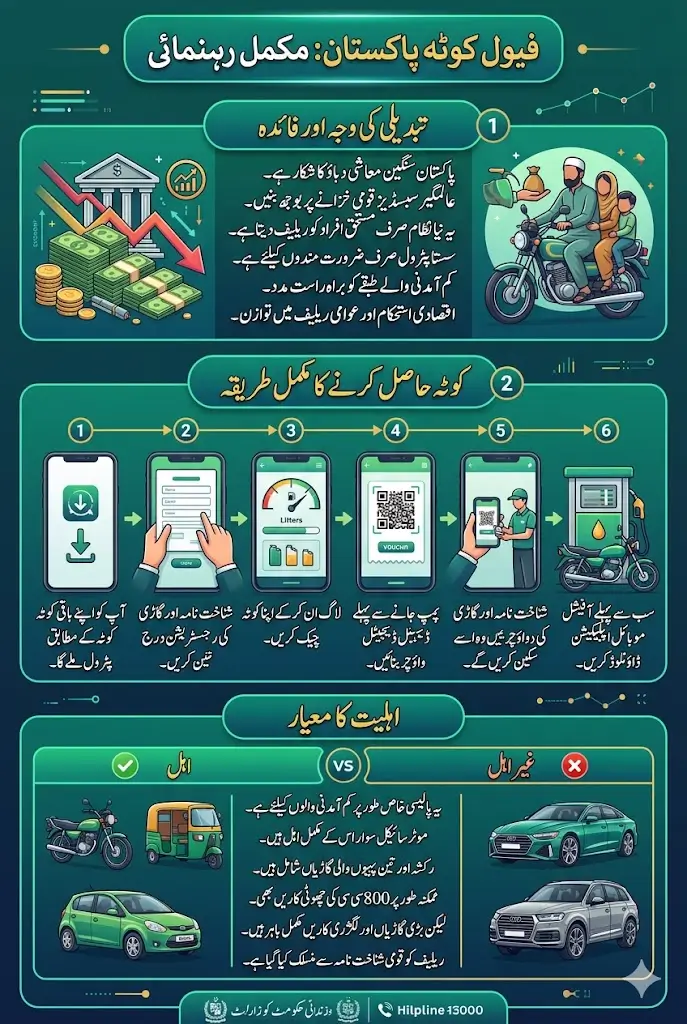
The fuel quota system in Pakistan will be based on modern digital technology, making it easier for citizens to access subsidized petrol while ensuring transparency. Every user will need to register through a mobile application using their CNIC and vehicle registration details. Once registered, a specific fuel quota will be assigned to each eligible user.
This quota will likely be fixed on a monthly basis. For example, motorcycle owners may receive a limited number of liters per month, ensuring that subsidies are used efficiently. The system will automatically track fuel usage, preventing over-consumption and misuse.
From a user’s point of view, the system is designed to be simple and straightforward. Instead of standing in long queues or dealing with manual verification, everything will be handled digitally. The app will act as a central platform where users can check their quota, generate vouchers, and manage their fuel usage.
You Can Also Read: Xiaomi Redmi Note 15 Pro Price In Pakistan
Step-by-Step Process to Get Subsidized Petrol
For ordinary citizens, understanding how to use the system is very important. The government has designed a step-by-step process that is easy to follow, even for those with basic smartphone knowledge.
First, users will install the official fuel quota app. After registration, they can view their allocated quota and generate a digital voucher before visiting a petrol pump. At the pump, the retailer will verify the voucher and provide fuel accordingly.
Here is how the process works:
- Download the official fuel quota mobile application
- Register using CNIC and vehicle registration number
- Log in and check your available fuel quota
- Generate a digital voucher before visiting the pump
- Present the voucher at the fuel station
- Retailer scans or enters the voucher details
- Receive fuel based on your remaining quota
This process ensures that every transaction is recorded and monitored, reducing chances of fraud or misuse.
You Can Also Read: SBP Announces New Facility for Non-Residents
Eligibility Criteria for Subsidy Under New Policy
The main goal of the new policy is to support low-income groups. Therefore, eligibility has been designed in a way that prioritizes people who rely heavily on fuel for daily income and transportation.
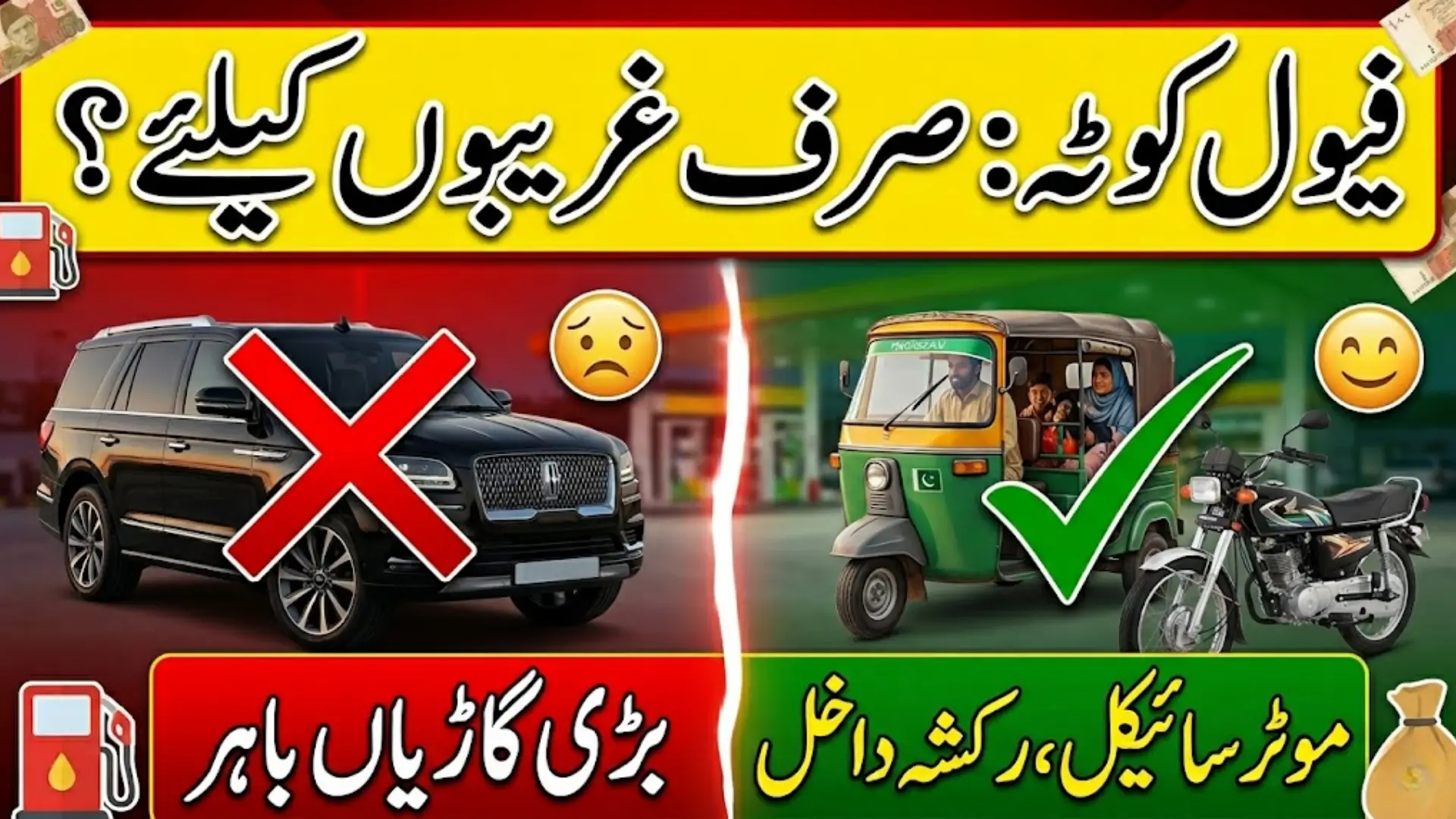
Two-wheelers and three-wheelers are at the center of this policy. These vehicles are commonly used by middle-class and lower-income families, as well as small business owners. There is also a possibility that small cars up to 800cc may be included, but this is still under discussion.
Eligibility highlights include:
- Motorcycles are fully eligible for subsidy
- Rickshaws and three-wheelers are included
- Small vehicles up to 800cc may be considered
- Larger cars and luxury vehicles are likely excluded
- Subsidy is linked to CNIC and vehicle registration
This targeted system ensures that benefits reach those who actually need financial support.
Digital Voucher System Explained in Simple Terms
The digital voucher system is the backbone of the fuel quota system in Pakistan. Instead of receiving a discount directly at the pump, users will generate a voucher through the app, which will determine how much fuel they can purchase.
When a user arrives at a petrol pump, the retailer will check the voucher using a dedicated app. The system will instantly verify the available quota and approve only the allowed amount. This means users cannot exceed their limit, even if they try.
For better understanding:
- If your quota is 20 liters, you cannot get more than that
- If only 10 liters are left, the system will allow only 10 liters
- Every transaction is recorded in real-time
- The system prevents duplicate or fake entries
This method is similar to systems used in government relief programs, making it reliable and efficient.
You Can Also Read: 1500 Prize Bond List 2026 Online Check
Role of Petrol Pumps and Retailers in New System
Petrol pumps are not just service providers in this system; they are key partners in its success. Retailers will be responsible for verifying vouchers, dispensing fuel according to quotas, and ensuring smooth operations at their outlets.
To avoid confusion, petrol pumps may allocate separate dispensers for subsidized fuel. This will help manage crowd flow and reduce delays for regular customers. Retailers will also be required to follow strict guidelines provided by the government.
Their responsibilities include:
- Verifying customer vouchers through official app
- Using designated devices for system operations
- Managing separate fuel lines or nozzles
- Providing accurate and fair service to all customers
This level of involvement ensures that the system works efficiently at the ground level.
Hardware Requirements and Cost Details
To implement this digital system, petrol pumps must install specific hardware. Each outlet will require at least two smartphones or devices to run the retailer application. These devices will be used to verify vouchers and manage transactions.
The government is coordinating with manufacturers to supply these devices. Retailers will need to deposit funds in a designated account to receive them quickly. This step is important to ensure that all petrol pumps are ready before the system is launched.
You Can Also Read: Silver Rate in Pakistan Today
Hardware Cost Overview
| Item | Details |
|---|---|
| Minimum Devices per Outlet | 2 |
| Estimated Cost per Device | Rs36,000 |
| Market Price per Device | Rs72,000 |
| Payment Method | Deposit to Govt Account |
This investment may seem significant, but it is necessary for building a transparent and efficient system.
Government Subsidy Plan and Pricing Mechanism
The government’s subsidy plan is now focused on efficiency rather than quantity. Instead of spending large amounts on universal subsidies, funds will be directed toward specific groups. This will help reduce financial pressure while still supporting those in need.
Authorities are also working to ensure that fuel prices are updated on time. This will protect petrol pump owners from losses and prevent issues like sudden shortages or hoarding.
Important aspects of the plan include:
- Direct subsidy for motorcycles and rickshaws
- Controlled and timely price adjustments
- Protection for fuel retailers
- Reduction in unnecessary government spending
This balanced approach aims to create stability in both the market and the economy.
You Can Also Read: Haval H6 Price In Pakistan Images, Reviews
Data Collection and Monitoring System
For any digital system to work properly, accurate data is essential. Oil Marketing Companies are required to submit complete details of focal persons for each petrol pump. This will help the government monitor operations and resolve issues quickly.
The data collected will be used for verification, communication, and accountability. It will also ensure that every fuel station is operating according to the rules.
Monitoring requirements include:
- Focal person name for each outlet
- CNIC for identity verification
- Mobile number for communication
- Real-time system tracking
This structured monitoring system will reduce corruption and improve transparency.
Technology Support and Training for Implementation
Since this is a new system, training and support are very important. The Ministry of IT will provide complete guidance to retailers through demos and video tutorials. This will help them understand how to operate the system efficiently.
The goal is to make the system user-friendly so that even people with limited technical knowledge can use it. Automation will reduce human errors and speed up the entire process.
Support features include:
- Step-by-step training videos
- Live demonstrations for retailers
- Technical assistance for troubleshooting
- Easy-to-use applications for both users and retailers
This ensures smooth implementation across the country.
Emergency Handling and Special Approvals
While the system is designed to be strict, the government has also included flexibility for emergencies. In special situations, users may request additional fuel through an approval process.
This is important because real-life situations cannot always follow fixed rules. Whether it is a medical emergency or urgent travel, the system will have provisions to handle such cases.
Key features of emergency handling:
- Special approval mechanism
- Controlled extra fuel allocation
- Monitoring to prevent misuse
- Quick response in urgent situations
This makes the system practical and adaptable.
Conclusion
The introduction of the fuel quota system in Pakistan marks a major shift in policy. It reflects the government’s attempt to move from short-term relief to long-term sustainability. While the system may take time to fully implement, its impact will be significant.
From a journalist’s perspective, this change is both necessary and timely. The country cannot continue spending billions on untargeted subsidies. At the same time, public support is essential for the success of this system.