
Benazir Taleemi Wazaif Payment Rise 2026
Benazir Taleemi Wazaif Payment Rise 2026 In Pakistan, education is often considered the only reliable path toward a better future, but for millions of families, it has become increasingly difficult to afford. Rising inflation has made school fees, uniforms, books, and daily travel expenses more expensive than ever. In rural and low-income urban areas, many parents are forced to delay or even stop their children’s education because they simply cannot manage both household expenses and schooling at the same time.
The Benazir Taleemi Wazaif Payment Rise 2026 has been introduced at a time when families are struggling the most. From ground observations, it is clear that even a small financial increase can help parents keep their children enrolled in school. This update is not just a policy change; it is a practical relief for families who want their children to continue studying but lack resources.
This guide explains everything in a simple and clear way so that every Pakistani household can understand who is eligible, how payments have increased, and how to make sure they receive the full benefit.
You Can Also Read: New Electricity Meter Rules in Pakistan 2026
Understanding the Purpose Behind Taleemi Wazaif
The Benazir Taleemi Wazaif program is designed to solve a very real problem in Pakistan: children dropping out of school due to financial issues. Instead of giving unconditional money, the program connects financial support directly with education, ensuring that children attend school regularly.
This approach has shown positive results in many areas. Families become more responsible about education, and children are encouraged to stay enrolled. Over time, this not only improves literacy but also helps break the cycle of poverty.
Main objectives of the program include:
- Encouraging regular school attendance among children
- Reducing dropout rates in low-income communities
- Providing targeted financial support for education
- Promoting long-term economic stability through education
You Can Also Read: Benazir Taleemi Wazaif Registration 8171 In April 2026
What New in the 2026 Payment Increase?
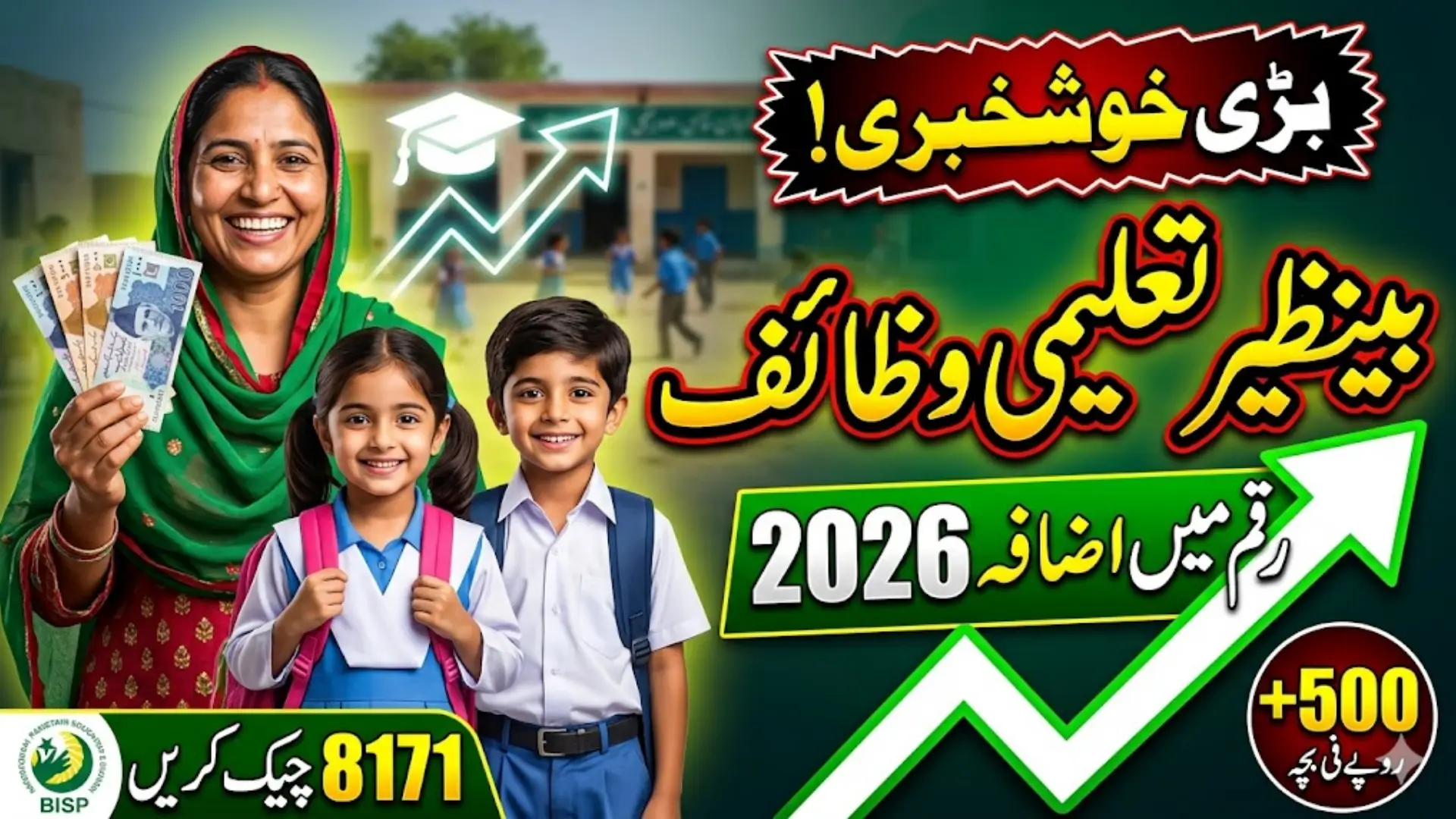
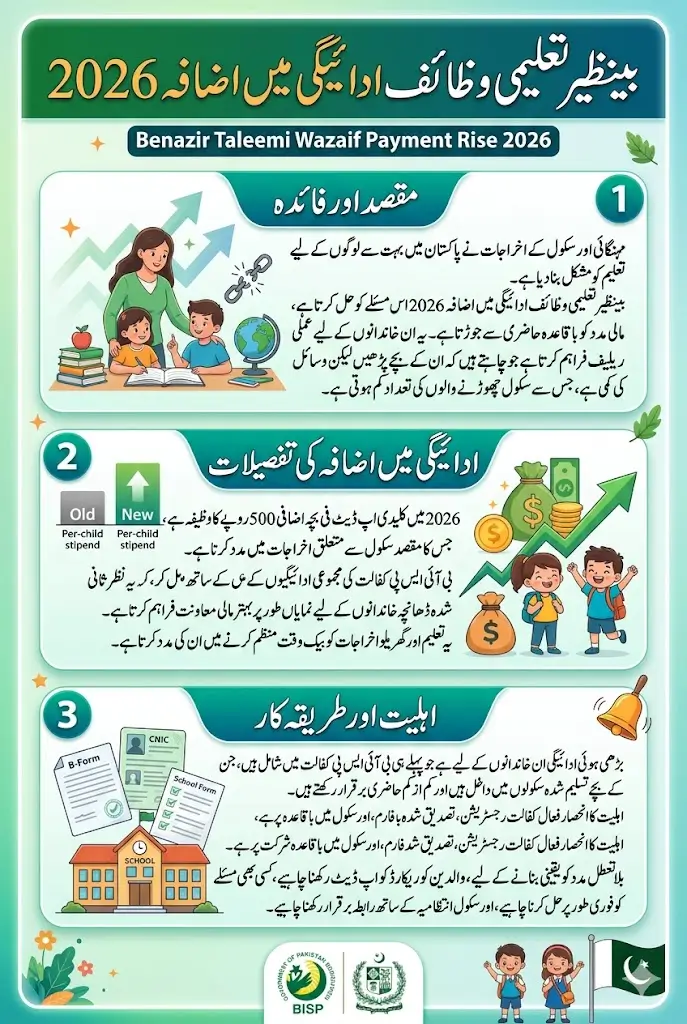
The government has revised the stipend structure in 2026 to provide additional financial support to families. The most important change is the increase of Rs. 500 per child, which directly adds to the education allowance provided under this program.
This increase is also connected with the overall rise in BISP Kafaalat payments. As a result, families now receive improved combined financial assistance, making it easier to manage both education and household expenses.
Key updates introduced in 2026:
- Rs. 500 additional stipend per child
- Increase in quarterly payments
- Higher overall BISP Kafaalat amount
- Better support for school-related expenses
For many families, this increase means they can now afford basic items like notebooks, uniforms, and transport without cutting down on essential household needs.
You Can Also Read: Fuel Quota Pakistan System on Cards Base
Who Qualifies for the Updated Payments?
The increased payments are only available to families who meet specific criteria under the BISP system. The program is structured in a way that ensures only deserving households benefit from the support.
Families must already be registered under the BISP Kafaalat program, and their children must be enrolled in a recognized educational institution. Attendance is also a critical factor, as payments depend on regular school participation.
Eligibility requirements include:
- Active registration in BISP Kafaalat program
- Children enrolled in a recognized school
- Minimum attendance requirement fulfilled
- Valid CNIC and verified B-Form records
If any of these conditions are not met, families may face delays or suspension in payments.
You Can Also Read: Ehsaas 8171 Web Portal 2026 Payment Reverification
Priority Families That Benefit the Most
Although the program is open to all eligible BISP families, certain groups benefit more due to their financial conditions. These are families who face daily challenges in managing education costs and are at higher risk of pulling their children out of school.
In many villages and underdeveloped areas, parents struggle to afford even basic school supplies. For such households, the increased stipend plays a crucial role in keeping children in the education system.
Priority beneficiaries include:
- Low-income households with limited income sources
- Women-led families managing household responsibilities
- Rural communities with fewer educational resources
- Families with multiple school-going children
You Can Also Read: EOBI Verification Check Online by CNIC By Sitting At Home 2026
New Payment Structure Explained Simply
To clearly understand the impact of the 2026 increase, it is important to look at how payments have changed. The increase may appear small, but when combined with other benefits, it significantly improves overall financial support.
| Category | Previous Amount | Updated Amount 2026 |
|---|---|---|
| Per Child Stipend | Standard Rate | + Rs. 500 Increase |
| BISP Kafaalat Payment | Rs. 13,500 | Rs. 14,500 |
| Education Support | Limited | Expanded |
This revised structure shows that families are now receiving better combined support, which helps reduce financial pressure and encourages consistent school attendance.
How to Start Receiving Increased Payments
Many families are eligible but still fail to receive payments because they are unaware of the correct process. From practical experience, most issues arise due to incomplete registration or lack of information.
To receive the increased payments, families must ensure that all requirements are fulfilled and records are updated. The process is straightforward but must be followed carefully.
Steps to receive payments:
- Confirm your registration in the BISP program
- Enroll your child in a recognized school
- Maintain regular school attendance
- Verify B-Form and family records
- Wait for confirmation through BISP system
Payments are usually released along with regular BISP installments, so families do not need to apply separately for the increase.
You Can Also Read: Xiaomi Redmi Note 15 Pro Price In Pakistan
Common Issues That Stop Payments
Despite being eligible, many families face payment issues due to small but important mistakes. Understanding these problems can help avoid unnecessary delays.
In most cases, payments are stopped because the system does not receive updated or verified information. Attendance records also play a key role in payment approval.
Common reasons for payment issues:
- Low or irregular school attendance
- Child not properly registered in the system
- Incorrect CNIC or family information
- Outdated NSER survey data
Addressing these issues on time can help ensure smooth and continuous payments.
Smart Ways to Ensure Continuous Payments
Families who actively manage their records and stay connected with the system rarely face payment interruptions. Small steps can make a big difference in ensuring long-term benefits.
Parents should take responsibility for maintaining attendance and keeping documents updated. Schools also play an important role in verifying student records.
Best practices for uninterrupted payments:
- Ensure children attend school regularly
- Keep B-Form and CNIC data updated
- Stay in contact with school administration
- Regularly check payment status via 8171
Difference Between Taleemi Wazaif and Regular BISP Support
Many people think that Taleemi Wazaif and general BISP payments are the same, but they serve different purposes. One focuses on education, while the other provides general financial relief.
Taleemi Wazaif is conditional, meaning families must meet education requirements. On the other hand, general BISP support is unconditional and helps manage daily household expenses.
Key differences:
- Taleemi Wazaif is for children’s education
- General BISP supports household needs
- Education payments depend on attendance
- Long-term vs short-term impact
Understanding this difference helps families make better use of both programs.
You Can Also Read: SBP Announces New Facility for Non-Residents
Real-Life Impact of the Payment Increase
From real-life observations in different communities, the increase in payments has already started making a difference. Families who were struggling to buy school supplies are now in a slightly better position.
For example, a mother with multiple children can now manage expenses like notebooks, uniforms, and daily travel more easily. This reduces the chances of children dropping out and allows them to continue their education without interruption.
Positive outcomes include:
- Improved access to school supplies
- Reduced dropout rates
- Less financial pressure on parents
- Better focus on children’s education
Role of Taleemi Wazaif in Pakistan’s Education Growth
The Benazir Taleemi Wazaif program is playing an important role in improving Pakistan’s education system. By linking financial assistance with school attendance, it ensures that children remain part of the education system.
This program is especially beneficial for girls’ education, which is often neglected in underprivileged areas. Over time, such initiatives contribute to building a more educated and stable society.
Key contributions to education:
- Increased enrollment in schools
- Support for girls’ education
- Reduction in poverty cycle
- Strengthening rural education systems
You Can Also Read: 1500 Prize Bond List 2026 Online Check
Conclusion
The Benazir Taleemi Wazaif Payment Rise 2026 is a meaningful step toward supporting low-income families across Pakistan. It not only reduces the financial burden of education but also encourages parents to keep their children in school.
Families who want to benefit from this program must ensure that their records are updated, children attend school regularly, and all eligibility conditions are met. This initiative is not just financial support; it is an investment in the future of Pakistan’s next generation.